
🖊️ Make Communications your Business Partner
6 Ways to Shape Business Strategy

Greetings from the Communications Kitchen, where we prefer to cook comms plans from scratch rather than pop a frozen meal in the microwave. As Samantha Hillstrom shared:
“When a leader comes to us saying they want to send an all-company email about something, the first question from comms should be: what problem are we solving?
It’s possible that an email might be the worst way to reach people on this topic.
Maybe we need a listening session where employees can ask questions in real time. Maybe a manager toolkit so the message comes from someone employees already trust. Maybe nothing at all, because we’re about to create noise where there’s already clarity.”
With this top of mind, I want to share more from leaders featured on The Switchboard and what they have to say about why communications should be business partners. Here’s why and how to make it a reality:
🔍 Evaluate Decisions Through a Comms Lens | Cath Anderson
🌅 Help Leaders Think, Not Just Write | Tori Barnes
🪑 Have a Seat & Ask Hard Questions: Samantha Hillstrom
⏳ Shape Decisions Before Made | Brooke Kruger
📛 Protect the Strategy & Ask the Hard Questions | Holly Nicola
💼 Declare Accountability and Integrate with the Business | Chuck Kaiser
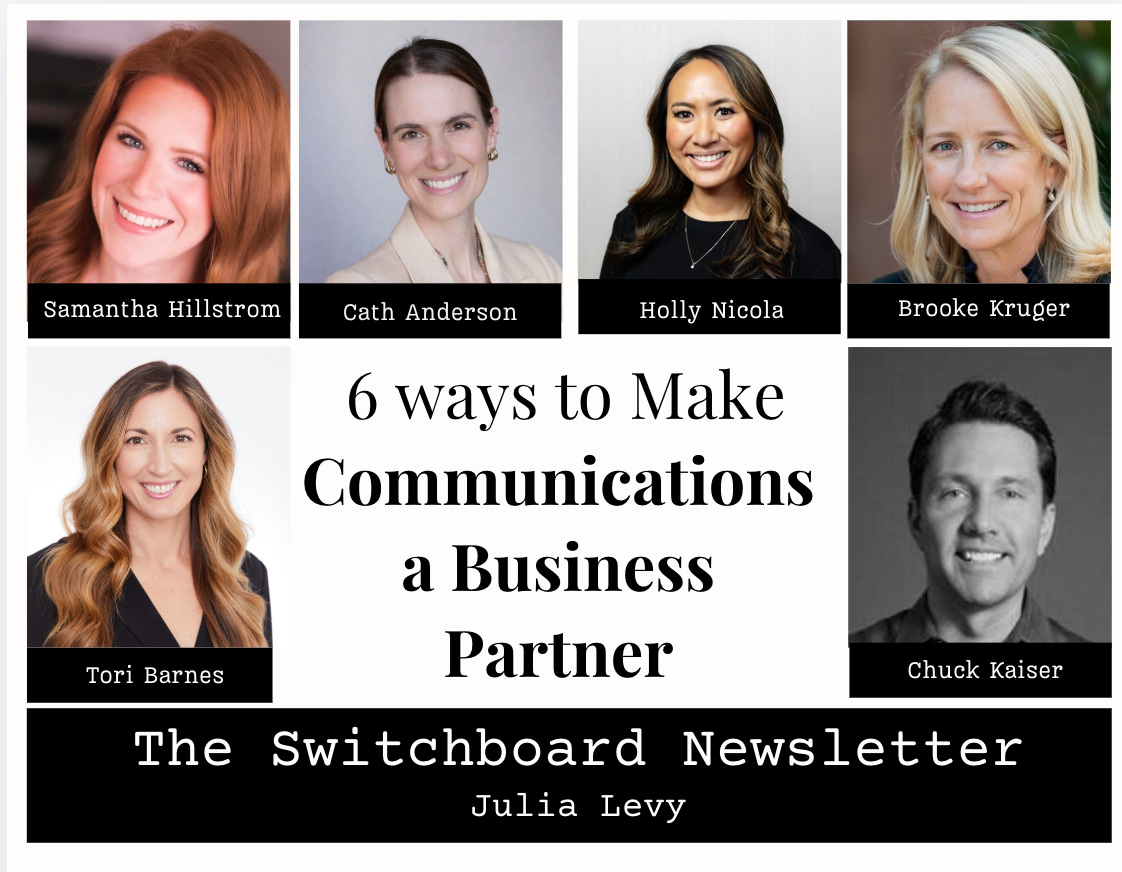
1. 🔍 Evaluate Decisions Through a Comms Lens | Cath Anderson
For Communications to truly be strategic, we have to be treated as a full business partner. Every business decision should be evaluated through a comms lens — assessing audience and ripple effects, looking around corners to scenario-plan and future-proof.
There are countless ways Comms can offer guidance and due diligence, often in ways similar to Legal. I’ve always believed these corporate functions are the quiet force behind the most dynamic, successful brands today.
2. 🌅 Help Leaders Think, Not Just Write | Tori Barnes
Communications becomes a business partner when we help leaders think, not just write. The strongest comms leaders shape decisions by challenging assumptions, surfacing risk, and helping leaders understand the potential impact of those decisions across stakeholders.
Getting there requires proximity and partnership. Comms leaders need relationships with CEOs and executives who value strategy, not just execution. It also requires understanding product, operations, revenue and growth well enough to contribute beyond messaging. In my experience, the smaller and more agile the organization, the easier it is to get into the trenches and demonstrate that value.
We also can’t underestimate the value of measurement, especially in the AI era. The more sophisticated we become at tying communications to business outcomes, the stronger and more durable our seat at the table becomes.
3. 🪑 Have a Seat & Ask Hard Questions | Samantha Hillstrom
To set up comms as a business partner, you need two things: proximity to decision-making and permission to push back. Proximity means being in the room, or as comms people like to say, “having a seat at the table,” when strategy is being shaped, not after decisions are baked.
Permission means leadership understands that comms will ask hard questions – not to be difficult, but because unclear strategy creates unclear communication, and unclear communication erodes trust.
When comms operates as a true business partner, we’re stress-testing decisions before they reach employees. We’re flagging gaps, surfacing what’s being left unsaid, and making sure the story holds up under scrutiny. That’s why embedding comms as a strategic function isn’t a nice-to-have. Poor communication derails execution, wastes leadership time, and damages trust that takes years to rebuild. Getting comms right from the start is a business decision.
4. ⏳ Shape Decisions Before They’re Made | Brooke Kruger
The communications function should serve as a business partner, not a service desk. Good communications leaders help shape decisions before anything is written. They have lived through crises, change, growth and mistakes.
These leaders ask the hard questions, challenge assumptions and flag risk all helping leaders decide what not to say or do. If a CEO only wants execution, communications will never be strategic no matter how strong the hire is.
5. 📛 Protect the Strategy & Ask the Stern Questions | Holly Nicola
Let’s be real: staying in the ‘order-taker’ lane is safer and way more comfortable, but it’s also the quickest way to stay invisible. Being a true partner is the ‘scary’ part because it puts you on the hook for the actual outcome, not just the word count—but that’s exactly where the magic happens.
When you stop protecting the process and start protecting the strategy, you stop being an overhead cost and start being a business multiplier. It’s not just about getting the email sent; it’s about having the guts to say, ‘Wait, is this actually going to work?’ and earning your seat as an indispensable advisor.
6. 💼 Declare Accountability and Integrate with the Business | Chuck Kaiser
For communications to be a true business partner, it must first declare itself as accountable for its contribution to the commercial process. Many communications teams hesitate due to the uncontrollable nature of numerous factors. Once we accept this, the focus shifts to identifying the right decisions throughout the entire process. This includes pairing the right messaging with the most relevant audience insights, executing effectively, and, where campaigns often fall down, investing in tools to ensure results attribution.
Many commercially-driven communications efforts are doomed from the start tied to lack of integration with sales and marketing. Integration is the first key. Then there’s a hard search for differentiation and to mold that unique value prop into the “story” that will break through and drive interest. That’s the set up. Then comes the important work of smart creative, sharpened targeting and rigorous measurement. When it all comes together, the result is pretty exhilarating.
The through-line across all of this seems to be that the value of comms isn't visible until it's missing and by then it's expensive. Samantha's point about permission to push back is underrated. Either leadership has built an environment where comms can flag risk early, or they haven't.
On the external side, we've been exploring some similar themes and just published a roundup with PR leaders on what narrative readiness actually looks like when trust is already low. A lot of the same logic applies, credibility isn't built at the moment of crisis, it's built in the work that comes before it. Sharing in case helpful for others: https://theattneconomy.substack.com/p/attention-experts-round-up-pr-and